
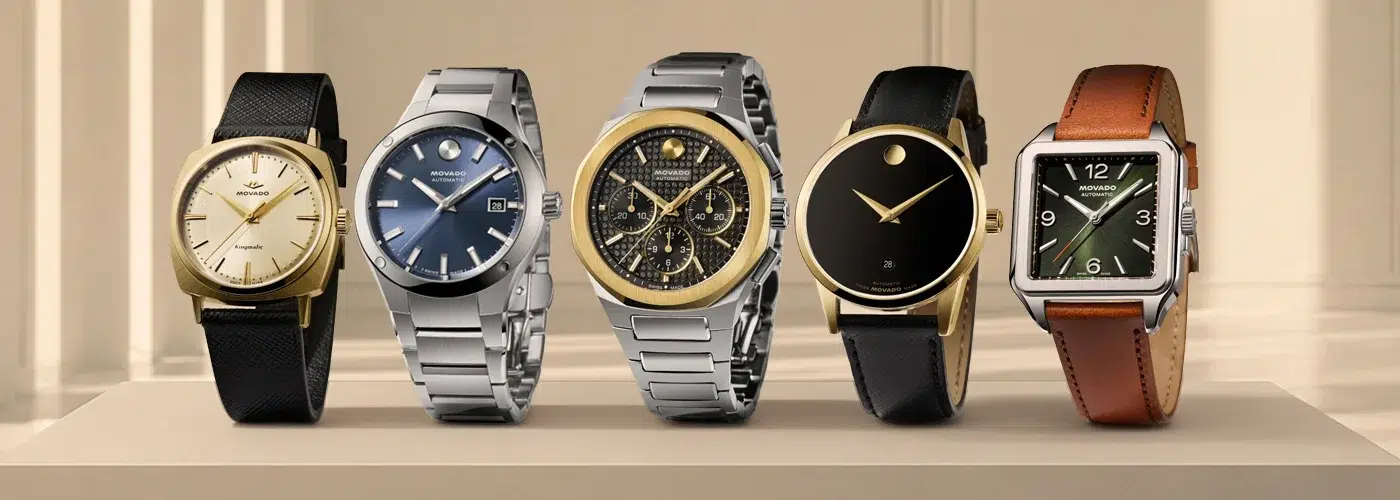

Where Movado Sits in the Watch Hierarchy
| Tier | Category | Representative Brands |
|---|---|---|
| Tier 1 | Ultra-Luxury / Haute Horlogerie | Patek Philippe, Audemars Piguet, Vacheron Constantin |
| Tier 2 | Core Luxury | Rolex, Omega, Cartier, Breitling |
| Tier 3 | Entry-Level / Accessible Luxury | Movado, Tissot, Hamilton, Longines |
| Tier 4 | Mass Market, Fashion Watches | Fossil, Daniel Wellington, MVMT |
I believe Movado is comfortably above mall-fashion brands, clearly below Omega and Rolex watches, and shares a tier with Tissot, Hamilton, and Longines. However, Iain Cahill, a luxury watch sales expert and who knows timepieces inside out, says,
“Movado competes with luxury watches on design far more than on horology.”
Why Movado Qualifies as Luxury
There are three main reasons why Movado qualifies as a luxury watch.
Genuine Swiss Heritage
Movado traces back to 1881 in La Chaux-de-Fonds, Switzerland, when 19-year-old Achilles Ditesheim opened his workshop. La Chaux-de-Fonds is still the heart of Swiss watchmaking.
The company adopted the name Movado, which means “always in motion” in Esperanto, in 1905. Over its history, the brand accumulated close to 100 patents and around 200 awards, which show a legitimate record of horological innovation.
Museum of Modern Art (MoMA) Fame
The calling card of Movado is the Museum dial, which features a stark black face with a single gold dot at 12 o’clock, representing the sun at high noon. Nathan George Horwitt, an artist, designed it in 1947.
It became the first watch dial ever admitted into the permanent design collection of the Museum of Modern Art in New York in 1960. Few watch brands can claim their signature design lives in an art museum.
Material Quality of Movado Watches
Movado uses materials consistent with most luxury watches:
- Surgical-grade 316L stainless steel cases and bracelets.
- Scratch-resistant sapphire crystals are on most core models with anti-reflective coatings.
- Real gold PVD coatings on premium Museum Classic timepieces.
According to a study published in the Journal Coatings on the evaluation of watch links, 316L austenitic stainless steel is defined as a benchmark standard for wristwatches due to its unique chemical makeup.
- Chromium (16% to 18%)
- Nickel (10% to 14%)
- Molybdenum (2% to 3%)
These are the same-grade materials you will find in genuine entry-luxury peers, well above the mineral glass and base alloys of fashion watches. On the other hand, standard fashion watches have mineral glass or acrylic crystal, base brass alloys or plated zinc for case metal, and cheap mass-produced quartz movements.
The Divide: What Enthusiasts Think vs. What the Public Thinks
There are essentially two Movados, depending on who you ask. My years working in the luxury watch market dealing with elite brands like Rolex, AP, RM, Patek, and Cartier confirm that serious collectors and the public view Movado through two entirely different lenses.

The Mainstream Perception
A Movado is a status symbol to the general public. It is a sleek, instantly recognizable dress watch and a meaningful milestone purchase. It shows taste and success without shouting. For most people who receive or buy one, it does exactly that job beautifully.
The Enthusiast or Horological Critique
Watch collectors are far more skeptical, and their criticism is based on two factors:
- Over-Reliance on Quartz: A large share of Movado’s catalog runs standard battery-powered quartz movements while carrying retail prices of $500 to $1,000+. Enthusiasts argue you are paying luxury money for a movement found in far cheaper watches.
- The Design Company Pivot: After Gedalio Grinberg’s North American Watch Corp. acquired the brand in 1983, Movado focused on positioning itself as a fashion-forward design house rather than a mechanical-engineering-first watchmaker. The watches became about how they look, not what is inside.
Movado’s Legal Dispute with the Museum Dial Designer
Designer Nathan George Horwitt spent years in a legal dispute with Movado over the use of his design. He alleges that the company used his design without proper compensation.
The matter was settled in 1975 for approximately $29,000, and Movado ramped up mass production of the Museum Dial after Horwitt’s death in 1990. It is an authentic and slightly uncomfortable wrinkle behind one of watchmaking’s most celebrated dials.
Financial & Market Reality: Will It Hold Value?
Reset your expectations now if you are thinking of a Movado as an investment.
- MSRP vs. Gray-Market Price: Movado watches routinely sell 30% to 50% below retail on the secondary and gray markets. If a model lists at $975, it is often findable new for well under $500.
- Resale Value: Modern lines, especially the popular Movado BOLD and other quartz fashion pieces, do not hold their value the way Rolex, Omega, and even some Tudor models do. Expect a significant decrease in the resale value the moment you buy a Movado watch.
- The Vintage Exception: Mid-century vintage Movados with historic in-house mechanical calibers from the pre-1970s era do attract genuine collector interest and can retain or increase in value. The value is due to the old mechanical watchmaking, not the modern quartz catalog.
Practical Takeaway: Never pay full MSRP for a modern Movado, and don’t buy one expecting it to be a store of value. Buy it because you love how it looks, ideally at a deep discount.
Also Read: Luxury Watch Prices in 2026
Movado vs. Direct Competitors: What Else Your Budget Buys
For the same money or less, Tissot, Hamilton, and Longines frequently deliver more actual watchmaking:
| Feature | Movado (Typical Core Model) | Tissot / Hamilton (Typical Model) |
| Movement | Often quartz | Often automatic and self-winding |
| Caseback | Usually solid / closed | Frequently exhibition (display) caseback |
| Buyer Appeal | Design, minimalism, and status | Horological value, mechanics, and heritage |
| Price Range | $500 to $1,000+ | Similar or lower |
If your priority is mechanical substance, an automatic movement you can watch spin through a clear caseback. Tissot and Hamilton generally out-spec Movado at the same cost. When I placed my Movado Museum Classic Automatic side by side with my Tissot PRX Powermatic 80, the structural differences became clear through their exhibition casebacks.
My Movado relies on a standard Swiss caliber, usually a modified Sellita SW200-1, which provides a baseline 38-hour power reserve and 30 meters of water resistance.
However, my Tissot has the highly optimized ETA-based Powermatic 80 caliber, which uses a titanium-alloy Nivachron hairspring for magnetic resistance. It offers an 80-hour power reserve and a 100-meter depth rating.
I evaluated them under a loupe here in our showroom at WatchMaestro and confirmed that Tissot structurally out-specs Movado at a lower market price point.
Movado vs. Fashion Brands (Michael Kors, Fossil)
Flip the comparison and Movado wins decisively. Movado offers superior build quality, Swiss-made credentials, sapphire crystals, and genuine 140+ years of heritage against Michael Kors, Fossil, and similar mall-fashion brands. This is the comparison where Movado’s luxury label is fully earned.
Fossil and Michael Kors cut costs by using mass-produced, unembellished Japanese quartz modules and cheap mineral glass. These watches run on generic Miyota (Citizen) or Hattori (Seiko) quartz calibers, which cost less than $5 to manufacture.
Final Verdict: Should You Buy a Movado?
Buy it if you:
- Love sleek, minimalist, modern-art-inspired design.
- Want an instantly recognizable dress watch.
- Appreciate MoMA’s design pedigree and clean aesthetics.
- Are buying at a genuine discount, not full MSRP.
Skip it if you:
- Want high mechanical craftsmanship and complex dials.
- Prefer an automatic movement with an exhibition caseback.
- Expect the watch to retain its financial value for resale.
- Would rather have horological substance than design-first styling.
I am saying this again: Movado is a real luxury brand, but just an accessible one, built on design and heritage more than mechanics. If you see this as an entry-level watch, it can be a genuinely satisfying timepiece. However, if you are expecting Rolex-level engineering or resale, you will be disappointed.
Frequently Asked Questions (FAQs)
Is Movado a high-end luxury brand?
Movado is an entry-level or accessible luxury brand. It is a genuine Swiss watchmaker that is above fashion brands like Fossil and Michael Kors. However, it is below core-luxury brands like Rolex and Omega. It shares its tier with Tissot, Hamilton, and Longines.
Are Movado watches worth the money?
They are worth it if you value minimalist design, the iconic Museum dial, and a recognizable dress watch, especially bought at a discount. They are less worth it if you want mechanical complexity or resale value, since many models are quartz and depreciate significantly.
Do Movado watches retain their value?
Modern lines like the Movado BOLD usually don’t retain value and sell 30% to 50% below retail on the secondary market. The exception is mid-century vintage Movados with historic mechanical movements, which can retain collector interest.
Why is the Movado Museum dial famous?
Nathan George Horwitt designed it in 1947. The single-dot Museum Dial became the first watch dial admitted into the Museum of Modern Art’s permanent design collection in 1960, giving it rare status as a museum-recognized design icon.
Is Movado better than Tissot or Hamilton?
It depends on your priorities. Movado wins on minimalist design and brand recognition. Tissot and Hamilton usually win on horology and offer automatic movements and exhibition casebacks at similar prices or even lower prices.
Are Movado watches Swiss-made?
Yes. Movado was founded in La Chaux-de-Fonds, Switzerland, in 1881 and remains a Swiss watch brand with close to 100 patents across its history.
