
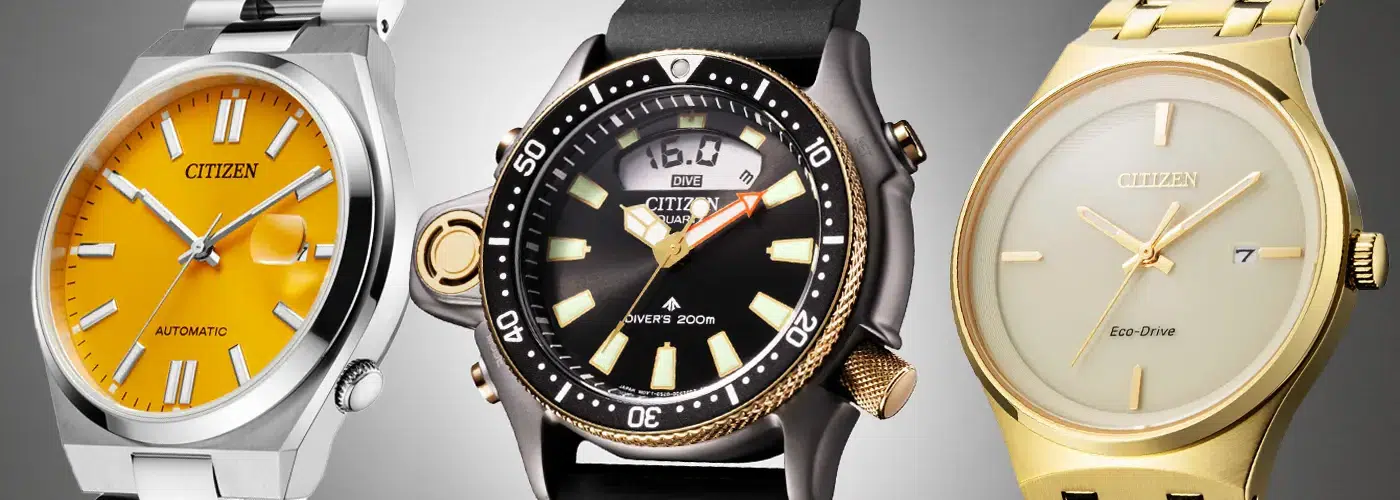

Why Citizen is Not a Fashion Brand
Many watch brands you see in department stores don’t make anything. They buy a movement, put a case around it, and print a logo on the dial. Citizen is the opposite. It is one of few companies in the world that makes the actual engine inside its watches.
- Citizen started in 1918 as the Shokosha Watch Research Institute and became Citizen Watch Co. Ltd. in 1930 (Source: Citizen Corporate History).
- In 1959, it built a movement factory in the town of Miyota, in Nagano, Japan. That factory developed into Miyota, one of the largest movement manufacturers on earth. Miyota makes its own mainspring and hairsprings, which are the two most complicated components in watches.
- Miyota movements are inside hundreds of other brands’ watches, including many microbrands you may already own.
- Citizen also bought Bulova in 2008, Swiss movement manufacturer La Joux-Perret in 2012, and Frederique Constant and Alpina in 2016.
When you buy a Citizen, you are buying from the company that other watch brands buy from. That’s a real quality signal.
Eco-Drive: One Thing Citizen Does Better Than Anyone
Eco-Drive is Citizen’s light-powered system. Citizen released the world’s first light-powered analogue quartz watch, the Crystron Solar Cell, in 1976, making 2026 the technology’s 50th anniversary. A solar panel sits under the dial, catches any light (sunlight, office light, a lamp), and charges a rechargeable cell inside the watch. You never change the battery.
Other brands have solar watches too. But Iain Cahill, our luxury watch expert and sales team lead at WatchMaestro says, Citizen’s version is simply the most mature, because the company has been refining it for decades and hides the solar panel under a normal-looking dial instead of an ugly patterned one.
What Eco-Drive Really Means Day to Day
| Question | Answer |
| Do I need to charge it? | No. Normal wearing under any indoor or outdoor light keeps the battery full. |
| What if I leave it in a drawer? | Most modern models run over 6+ months in total darkness and considerably longer on power-save models claim years. |
| Does the solar panel wear out? | Effectively no. It lasts the life of the watch. |
| What actually fails? | The rechargeable storage cell, usually after roughly 20 years. It is a replaceable part. |
| How accurate is it? | Typically around 15 seconds per month, which is far better than virtually all mechanical watches. |
Eco-Drive “never needs a battery.” More precisely, it never needs a battery change, but it may need a capacitor change once or twice across a very long life, says Iain Cahill.
Citizen Watches: Cost Per Year
Take a typical $350 Eco-Drive diver you plan to keep for 20 years.
- Purchase price: $350
- Battery changes over 20 years: $0
- One capacitor and seal service about 20 years: roughly $75 to $150
- Total: About $425 to $500, or roughly $21 to $25 per year
Now take a $350 mechanical watch kept the same 20 years.
- Purchase price: $350
- Service every 7 years or so, three times: roughly $150 to $250 each
- Total: $800 to $1,100, or roughly $40 to $55 per year
And a $350 standard quartz watch:
- Battery changes every 2 years, ten of them: roughly $300+
- Plus the risk that one leaks and kills the movement
Eco-Drive wins on cost, wins on convenience, and removes the single most common cause of dead watches: a forgotten battery that leaked. A mechanical watch has moving parts you can watch. An Eco-Drive does not. That preference is yours to make, but don’t let anyone tell you Eco-Drive is the cheap choice. It is the low-maintenance choice.
Citizen Watches Range

Citizen’s biggest problem is that it sells too many watches with confusing names.
Entry-Level (About $120 to $250)
These are basic Eco-Drive dress and sports watches. Mineral crystal, printed dials, folded-link or thin bracelets, often no lume. These are fine and reliable watches. They are not exciting, and they feel like their price. Buy one if you want a set-and-forget watch, not if you want to fall in love with it.
The Sweet Spot (About $250 to $800)
This is where Citizen is genuinely hard to beat.
- Promaster: Divers, pilot, and field watches. The dive models are ISO 6425 certified, the international standard for a professional diver’s watch, covering water resistance, legibility in darkness, shock and magnetic resistance, and strap strength. Plenty of watches claim “200m.” Far fewer carry the certification. Tough, strong lume, honest tool-watch design.
- Tsuyosa: A well-liked integrated-bracelet automatic at around $475 US MSRP. Sapphire crystal, 40mm case, Miyota 8210 automatic movement with a 42-hour power reserve and hacking seconds, and a wide range of bright dial colors. One caveat: water resistance is 50m, not 100m. That is fine for handwashing and rain, and Citizen rates it for still-water swimming, but it is a dress-sports watch rather than a swimming watch. If you want an automatic you can genuinely swim in, look at Promaster instead.
- Eco-Drive Chronographs: Solid, practical, no battery worry.
If you only remember one thing: most people asking “are Citizen watches good” should be shopping in this band.
Premium Citizen Watches (About $800 to $2,500)
Attesa and Series 8 live here, plus Super Titanium models and satellite-synced Satellite Wave GPS watches. You get better finishing, sapphire crystal, and Citizen’s Duratect surface hardening. Duratect is worth understanding in numbers rather than adjectives. Citizen states the treatment achieves a hardness rating of over 1,000 HV (Vickers) and describes finished Super Titanium as roughly five times harder than stainless steel.
Independent coverage puts specific Duratect processes at 1,300 to 1,500 HV, with some finished Super Titanium measured as high as 1,700 to 2,300 HV. For comparison, 316L stainless steel sits around 180 to 210 HV. A Super Titanium Citizen resists everyday scratching far better than a steel watch, and it is lighter on the wrist. Very few brands at any price offer that combination.
High-End Timepieces (About $3,000 and Up)
The CITIZEN and Campanola. CITIZEN watches are hand-assembled in a small workshop in Nagano. Two standouts are:
- Caliber 0100: This is accurate to about +-1 second per year, without any satellite or radio signal. It uses a high-frequency AT-cut crystal oscillator running far faster than a normal quartz crystal. It is one of the most accurate wristwatches ever made (Source: Citizen Caliber 0100)
- Caliber 0200: This is an automatic mechanical movement developed with La Joux-Perret and built in Japan. It runs at 4Hz with about 60 hours of power reserve and is rated -3/+5 seconds per day, which is chronometer territory.
What Citizen Does Badly
A fair review of citizen watches has to include this.
Mineral Crystal Appears at Prices Where It Should Not
Crystal type varies unpredictably across the range, and mineral glass appears on models where buyers reasonably expect sapphire. Always confirm on the spec sheet rather than assuming price equals sapphire.
The Catalog is a Maze
Citizen sells overlapping models with near-identical looks and cryptic reference numbers like BN0150-28E. Two watches that look the same can have different crystals, lume, and movements. You have to read specs, not just look at photos.
Resale Value is Weak
Seiko has a bigger enthusiast community, so Seikos resell better. Expect to lose a lot on a Citizen if you sell it. Buy a Citizen to wear, not to flip.
Out-Of-Warranty Repair Can Be Annoying
A capacitor swap at an independent watchmaker often starts around $75. But if Citizen decides the whole module must be replaced, quotes can run into hundreds. It is painful on a watch that costs $300. On cheaper models, plan for the watch to be genuinely disposable after 15 to 20 years.
Brand Prestige is Low Relative to Quality
At the top end, this is arguably a feature (you get finishing and accuracy that compete with watches costing several times more), but if you want a watch that impresses strangers, Citizen is not that.
Also Read: Is Movado a Luxury Brand
Warranty: Check Your Region
- In the UAE, authorized retailers usually issue a 3-year regional warranty plus a 1-year international warranty.
- Citizen’s five-year limited warranty covers the U.S, Canada, the UK, Ireland, Caribbean and Mexico. The warranty excludes the power cell, case, crystal, stem, crown, bracelet, clasp, links, pins, screws, and straps.
- Globally, Citizen extended its standard warranty from 1 year to a 3-year international warranty, effective 1 October 2025, valid in any country rather than only the country of purchase.
The warranty only applies if you buy from an authorized retailer and get a stamped warranty card. Grey-market sellers are usually cheaper for a reason.
How to Pick a Good Citizen Watch in Five Minutes
Use this checklist on any Citizen model before you buy:
- Crystal: Sapphire is what you want. Mineral is acceptable only under about $250.
- Movement Type: Eco-Drive if you want zero maintenance. Automatic (Miyota 82xx or 9015) if you want a mechanical feel. Standard quartz only if the price is very low.
- Water Resistance: 100m minimum if you swim regularly. 30m means splashes only, whatever the ads suggest; 50m covers handwashing, rain and the occasional dip, but not laps or diving. Note that this rules out the Tsuyosa as a swimming watch, which is a genuine trade-off for its looks and price, not an oversight.
- Case Size: Citizen runs large. Check the lug-to-lug measurement, not just the diameter. Some Promasters are 46mm wide and 16mm thick, these are genuinely big.
- Lume: Cheaper models often have little or none. If you need to read the time at night, confirm it.
- Bracelet: Look for solid links and a screwed-link or well-made clasp. This is the fastest way to tell a $150 Citizen from a $500 one.
Also Read: Entry Level Watches to Start a Collection
Citizen vs. Alternative Watch Brands
| Factor | Citizen | Seiko | Bulova |
| Biggest Strength | Light-powered tech, accuracy, zero maintenance | Mechanical heritage, huge community | Bold designs, high-frequency quartz |
| Biggest Weakness | Confusing lineup, weak resale | Quality control varies, prices rising | Thinner enthusiast following |
| Best For | People who want a watch that just works | People who want a mechanical hobby | People who want unique style |
| Note | Owns Bulova since 2008 | Independent | Owned by Citizen |
Interestingly, if you compare Citizen and Bulova, you are comparing two brands under the same parent company. So, it becomes a pure question of taste rather than corporate quality.
So, Are Citizen Watches Good?
Here is the verdict, split by buyer:
- You want one reliable watch for the next 20 years, and you never want to think about it. Yes. Buy an Eco-Drive in the $250 to $600 range with a sapphire crystal. This is the single best use case for the brand, and almost nothing competes with it.
- You want a tough diver or pilot watch for real use. Yes. Promaster is excellent and the divers are ISO 6425 certified; just verify the crystal.
- You want to get into mechanical watches as a hobby. Maybe. The Tsuyosa is a great, affordable start, but Seiko has a deeper community and more upgrade paths.
- You want a high-accuracy or high finishing piece and don’t care about badge prestige. Strongly yes. The CITIZEN line offers accuracy and finishing that Swiss brands would charge several times more for.
- You want the cheapest watch with a known name on the dial. Technically yes, but you will get a forgettable watch. Spend a little more or buy a G-Shock.
Frequently Asked Questions (FAQs)
How long does a Citizen Eco-Drive actually last?
The solar cell lasts the life of the watch. The rechargeable storage cell typically retains a good charge for about 20 years years and can then be replaced. Citizen claims 40 years. The movement itself is commonly rated for 20+ years.
Do Eco-Drive watches need sunlight specifically?
No. Any light works, including indoor lighting. Sunlight just charges much faster. A few hours of direct sun per month is more than enough for most models.
Can I overcharge a Citizen watch?
No. The movement has overcharge protection. The only real risk is heat. Don’t leave it pressed against a hot bulb or a car dashboard in summer.
My Eco-Drive second hand is jumping in 2-second steps. Is it broken?
No. That is the low-charge warning. Put it in bright light for several hours.
Is the Citizen Promaster a real dive watch?
Yes. The Promaster Diver line is ISO 6425 certified with 200m water resistance, a unidirectional bezel, and a screw-down crown and caseback. It meets the international standard for a professional diver’s watch, which many watches marked “200m” do not.
Is Citizen better than Seiko?
Neither is simply better. Citizen wins on light-powered technology, quartz accuracy, and low maintenance. Seiko wins on mechanical watches, community and resale. Pick based on which of those you care about.
