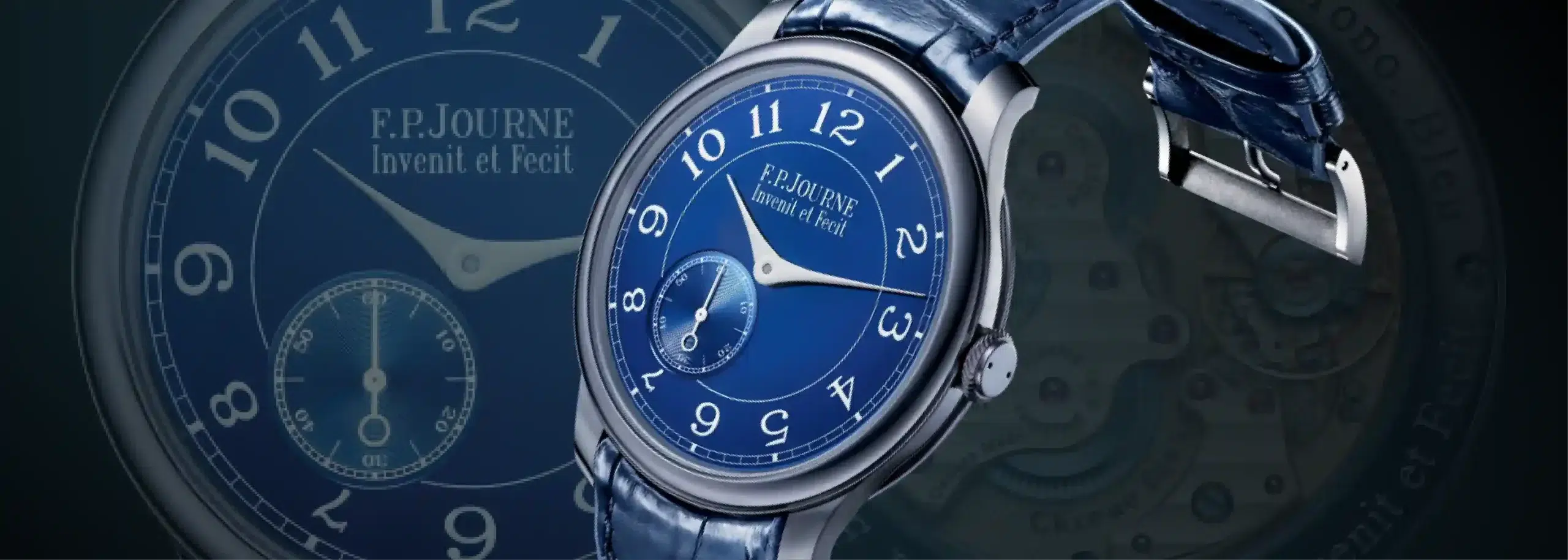

F.P Journe Chronometer Bleu: Technical Specifications
| Feature | Details/Specs |
|---|---|
| Reference | CS BLEU (Classique Collection) |
| Case Material | Polished Tantalum |
| Case Dimensions | 39mm Diameter x 8.6mm thickness (46mm Lug-to-Lug) |
| Movement | In-house Caliber 1304 Manual-Wind |
| Movement Material | Solid 18k Rose Gold |
| Power Reserve | 56 Hours via Twin mainspring barrels in parallel |
| Frequency | 21,600 vibrations per hour (3 Hz) |
| Water Resistance | 30 meters (3 ATM) |
The Origin of the Chronometer Bleu
When Francois-Paul Journe conceived the Chronometer Bleu, often abbreviated as the CB, in 2008, the global financial situation was very volatile. The skyrocketing prices of traditional precious metals like platinum and gold forced the Geneva manufacturer to explore alternative, non-traditional materials.
Journe turned to tantalum instead of scaling back on movement complexity or finishing standards. Tantalum is a dense and stubborn transition metal rarely used in haute horlogerie. The company released the watch in 2009 as an entry point into the brand’s Classique collection. However, its unique composition turned it into one of the most sought-after F.P. Journe watches in independent watchmaking.
The Metallurgy: Machining and Polishing Tantalum
Tantalum is nearly as heavy as gold and possesses a dark, bluish-gray hue that sets it apart from titanium or steel. It has a density of 16.3 g/cm³. Although its physical properties make it resistant to corrosion and wear, they make it very difficult to shape.
- High Melting Point: Tantalum melts at approximately 3,000 degrees Celsius and requires specialist equipment to cast.
- Tool Wear: The metal is very ductile but abrasive, which can quickly wear down cutting tools during CNC machining.
- Combustibility: Fine tantalum dust generated during the milling process is highly flammable.
While other luxury watch brands leave tantalum with a matte, bead-blasted, or brushed finish to hide imperfections, the Chronometer Bleu features a fully polished case. It has a 39mm case in diameter with 8.6mm thickness, which makes it sleek. Yet, it feels as heavy as platinum on the wrist and offers a solid and reassuring physical presence.
The immense difficulty of working with this alloy is why the metal remains an anomaly for the brand. As Francois-Paul Journe himself later reflected on the production bottleneck:
As the Chronomètre Bleu was successful, I was asked to make other models in tantalum. I always refused, because the difficulty of manufacturing and the time available meant that we couldn’t meet these requests.
Tantalum Rivals and Family Siblings

I looked at how other brands use tantalum to understand why the Chronometer Bleu is so special. For instance, the Omega Seamaster 300M Tantalum uses this heavy metal as a dark accent paired with titanium and rose gold. The watch has a brushed or bead-blasted finish and looks like a heavy, sporty tool.
Similarly, the Audemars Piguet Royal Oak Tantalum models from the past used a brushed finish to emphasize industrial lines. The Chronometer Bleu is completely different. Journe insisted on a fully mirror-polished tantalum case. Polishing a stubborn metal like tantalum is rare because the polishing wheels get clogged quickly.
I also compared the watch to its sibling, the Chronometer Souverain (CS). The CS is a traditional model made of gold or platinum with a silver or gold guilloche dial. The CS features a power-reserve indicator at 3 o’clock. The Chronometer Bleu strips this power-reserve indicator away, which leaves a clean, symmetric face that highlights the vibrant chrome-blue lacquer dial instead of classical watch metal.
The Dial: A Dynamic Chrome Blue Surface
The dial of the F.P. Journe Chronometer Bleu is famously difficult to capture in photographs. Instead of using a standard galvanic treatment, the Geneva manufacturer applies multiple layers of blue lacquer to a metal base, which are then hand-polished to a high-gloss, mirror-like finish. Even the smallest speck of dust can ruin the dial. That’s why the production yield is very low. The brand has reportedly rejected a high percentage of finished dials during quality control.
The dial layout showcases Journe’s signature aesthetic:
- Ivory-Printed Numerals: The Arabic numerals are printed in a cream or ivory color, which matches the steel hands.
- Off-Center Sub-Seconds: The subsidiary seconds hand is placed uniquely at 7:30.
- Scaling Typography: The numbers “7” and “8” shrink in size to frame the sub-seconds register to avoid cutting off the numerals at the bottom of the dial. This is a subtle but brilliant design detail.
The Caliber 1304: A Solid Gold Movement
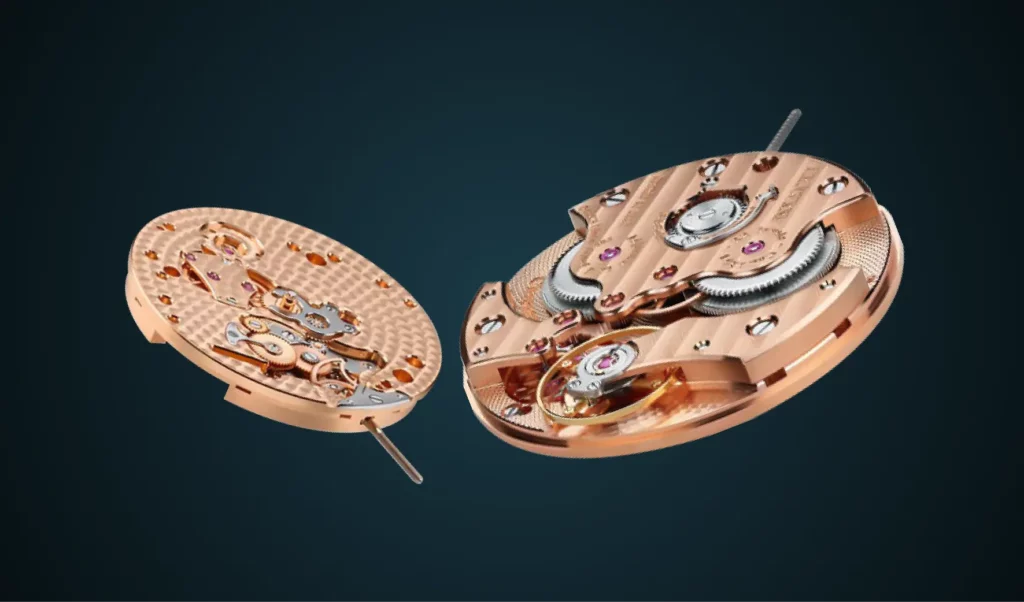
Although the exterior of the Chronometer Bleu is beautiful, the movement visible through the sapphire caseback is what strengthens its legendary status among collectors. Unlike Swiss movements made of brass, the plates and bridges of the manual-wind Caliber 1304 are made of solid 18k rose gold.
Journe designed the wheel train to sit entirely beneath the dial plate to enhance visual symmetry. This leaves a wide, open space in the center of the movement, drawing the eye to the twin mainspring barrels working in parallel and the free-sprung balance wheel. The finishing features traditional anglage (hand-beveling) on the gold bridges, delicate perlage on the base plate, and barleycorn guilloche between the mainspring barrels.
The Verdict on Scarcity and Market Value
F.P. Journe removed the Chronometer Bleu from its public price list around 2021. The company retired the model from standard production. The brand produces fewer than 1,000 total timepieces per year across all collections; the supply of the Chronometer Bleu remains exceptionally low.
Today, obtaining one directly from the official boutique is generally reserved for the brand’s most dedicated collectors with extensive purchasing histories. Thus, this stark contrast between low production volumes and massive global demand has sustained its status as a cornerstone of modern independent horology.
Resale Market Dynamics: From Retail to Six-Figure Icons
Initially, the retail price of the Chronometer Bleu was under $20,000. However, the secondary market has completely transformed. In May 2026, a standard Chronometer Bleu sold at Christie’s in Switzerland for $163,400. In the same month, Sotheby’s sold another watch for $181,215, and Antiquorum hammered one for $168,915.
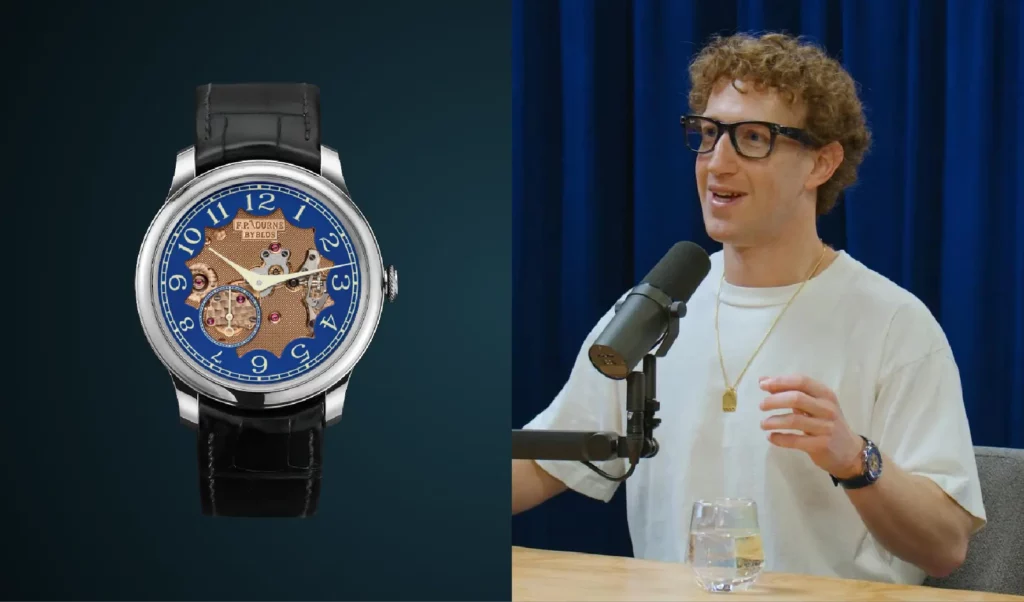
The prices are even higher for the ultra-rare limited editions. The Chronometer Bleu Byblos is a semi-skeletonized version limited to only 99 pieces. It features a cut-out dial showing the gold movement beneath. In June 2026, a Byblos edition previously owned by football player Tom Brady sold at Sotheby’s auction for a staggering $537,600.
Also Read: Tom Brady Flaunted $500,000 Blue Ceramic AP Royal Oak Perpetual Calendar
Collector Voices and Cultural Status
The Chronometer Bleu has earned a unique cult status among elite watch collectors. Logan Baker, a specialist at Phillips Perpetual, once remarked that this watch became legendary because collectors slowly realized just how good it was, rather than relying on initial marketing.
The watch is also popular with prominent global figures. Meta CEO Mark Zuckerberg was seen wearing his own Chronometer Bleu Byblos during a podcast in 2025. Eugene Tutunikov, the CEO of SwissWatchExpo, commented on Zuckerberg’s watch choice:
It is one of those pieces that quietly signals, I know what I am wearing, without shouting it.
I believe this sentiment captures why the Chronometer Bleu is highly regarded. It is because the watch represents deep horological knowledge rather than flashy wealth.
Critique of F.P. Journe Chronometer Bleu: A Collector’s Reality
No watch is entirely without compromises. Here is my balanced assessment of the Chronometer Bleu with a few practical ownership details:
- Fingerprint Sensitivity: The polished tantalum case and mirror-like chrome blue dial readily attract oils and fingerprints, which requires regular cleaning to preserve their luster.
- Lack of Hacking Seconds: The Caliber 1304 does not feature a hacking mechanism. Precision time-setting requires applying slight backward pressure on the crown.
- Stiff Winding Profile: Although the crown features a beautiful rope-like knurling, its flat profile can make manual winding of the twin mainspring barrels feel stiff to the touch.