
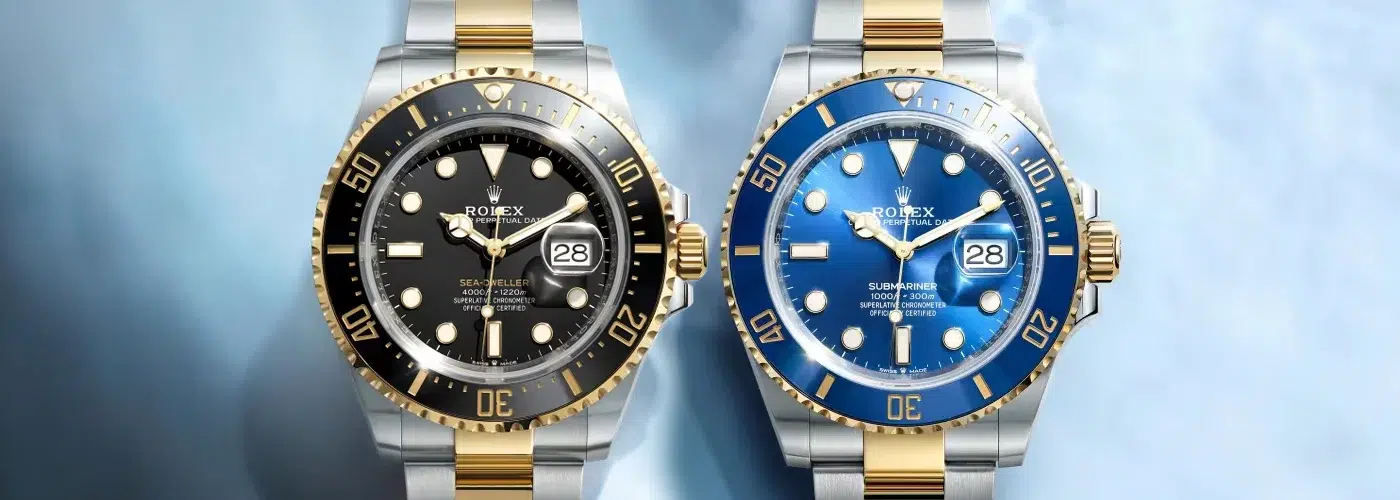

Rolex Sea-Dweller vs Submariner: Quick Comparison
| Feature | Submariner Date 126610LN | Sea-Dweller 126600 |
|---|---|---|
| Case diameter | 41 mm | 43 mm |
| Thickness | approx. 12.5 mm | approx. 15 mm |
| Lug width | 20 mm | 21 mm |
| Water resistance | 300 m / 1,000 ft | 1,220 m / 4,000 ft |
| Helium escape valve | No | Yes |
| Crystal | Sapphire with Cyclops | Thicker sapphire with Cyclops |
| Movement | Calibre 3235, approx. 70 h power reserve | Calibre 3235, approx. 70 hours power reserve |
| Bracelet clasp | Oysterlock with Glidelock | Oysterlock with Glidelock + Fliplock |
| Approx. retail (USD) | approx. $10,250 | approx. $14,550 |
| Best for | Daily wear, smaller wrists | Bigger wrists, tool-watch lovers |
Retail prices move with Rolex’s annual adjustments and local taxes. Always confirm with an authorized dealer before you buy.
1,220 Meters of Water Resistance

The Rolex Sea-Dweller was designed for commercial saturation diving, offering capabilities far beyond standard dive watches. Although a standard Rolex Submariner is rated for 300 meters, which is well past the 40-meter recreational scuba limit and the 100-meter technical diving threshold, the Sea Dweller serves a highly specialized professional purpose.
Standard dive watches can’t survive the decompression phase of saturation diving because helium molecules penetrate the watch seals. The Sea-Dweller solves this problem with a dedicated helium escape valve. Its core appeal rests on being a certified piece of professional equipment built for the world’s most extreme underwater environments, rather than casual recreational swimming.
Helium Escape Valve
When commercial divers spend time inside a deep-sea saturation chamber, they breathe a gas mix containing helium. Because helium molecules are small, they can slip past a watch’s rubber gaskets and build up inside the watch case.
The danger happens when the chamber depressurizes to return the divers to normal atmospheric pressure. As the pressure drops, the trapped helium gas expands quickly. Without a way to escape, this built-up internal pressure will pop the watch’s crystal right off the face.
To solve this, Rolex and the French diving company COMEX co-developed the helium escape valve in the 1960s. This feature is a one-way pressure release built into the left side of the watch case. It remains sealed underwater to prevent leaks, but automatically opens to vent gas during the slow decompression process.
Do you actually need a helium escape valve? Almost certainly not. Unless you are a professional saturation diver working offshore, this valve is a cool design detail and a conversation starter rather than a feature you will ever use.
Choosing the Right Size
On paper, the Rolex Submariner is 41 mm and the Rolex Sea-Dweller is 43mm. However, the Sea-Dweller feels much larger on the wrist because of it is 2.5 mm thicker and significantly heavier. This extra bulk comes from the thicker crystal and reinforced case back required to withstand depths of 1,220 meters.
According to Iain Cahill, a watch enthusiast with years of experience and sales manager at WatchMaestro dealing with hundreds of clients every month:
- Under 6.75 inches (17 cm): Choose the Submariner because it sits flat and fits comfortably under a shirt cuff.
- 6.75 to 7.25 inches (17 to 18.5 cm): Both models fit. Try both on to see which weight you prefer.
- Over 7.25 inches (18.5 cm): Choose the Sea Dweller because it looks proportional on larger wrists, where the Submariner might look too small.
Bracelet and Clasp Comparison
Both watches feature the premium Oyster bracelet with an Oysterlock safety clasp and the Glidelock extension system. This system lets you adjust the bracelet length by up to 20 mm in 2 mm increments without using any tools, making it easy to resize your watch when your wrist expands in hot weather. However, the Sea-Dweller includes an extra feature:
- Fliplock extension link: This adds an extra 26 mm of length instantly.
- Purpose: It allows the watch to fit over a thick wetsuit or dry suit sleeve.
Cahill says, while the Fliplock link is practical for professional scuba divers, it adds extra bulk inside the clasp that everyday wearers may find unnecessary.
Dial, Bezel, and Legibility
The Rolex Sea-Dweller and Rolex Submariner share a legendary diving heritage but feature distinct design choices. On the dial, the Sea-Dweller displays red “SEA-DWELLER” text, a feature reintroduced in 2017 to honor the 1967 original model.
While many collectors love this historical nod, others feel it makes the face look busy, whereas the Submariner maintains a cleaner and more anonymous dial layout.
Both use a unidirectional 60-minute Cerachrom bezel, which is an important safety feature because an accidental knock will only shorten your calculated dive time rather than lengthen it.
Both watches also share Chromalight lume that emits a long-lasting blue glow, making their legibility virtually identical in dark underwater conditions.
However, the biggest visual shift occurs with the date window. The Sea-Dweller only began using a Cyclops date magnifier in 2017, which means older versions lack this magnifying lens.
If you shop a pre-owned Rolex watch, this is an important detail to verify in the product photos depending on which style you prefer.
Movement and Accuracy
Both watches use the Rolex Caliber 3235 movement, which includes the efficient Chronergy escapement and a Parachrom hairspring. This system gives both models a strong 70-hour power reserve.
Both watches also have the Superlative Chronometer certification. This means they are highly accurate, keeping time within -2/+2 seconds per day. Because they share the same internal parts, neither watch has an accuracy advantage over the other.
When choosing between them, the anti-magnetic Parachrom hairspring is actually more useful for daily wear than a high water-depth rating. Most people rarely dive deep into the ocean, but everyone encounters magnetic fields every day.
Items like smartphones, laptops, and speakers can disrupt a mechanical watch’s timing. The anti-magnetic hairspring protects the watch from these common electronic threats, making it reliable for everyday use.
Price, Value, and Resale
At retail, the Submariner costs $10,250 or AED 37,650, while the Sea-Dweller is priced higher at $14,550 or AED 53,450. However, the resale market dynamically changes this value.
The 41mm Submariner has a universally wearable size and massive global demand. That’s why it has a consistent and high premium, so pre-owned timepieces trade between $13,000 and $16,000. It is approximately AED 47,750 to AED 60,600.
On the other hand, the larger 43mm Sea-Dweller appeals to a much smaller niche of collectors. That’s why its secondary market price is between $11,000 and $15,000 or approximately AED 40,400 to AED 55,100.
Thus, the Sea-Dweller usually sells below its original retail price. The Submariner is a clear winner if you are looking for instant liquidity and safer value retention.
The 15g Difference You Will Actually Feel
When choosing between the Rolex Submariner and the Sea-Dweller, don’t just look at how deep they can go underwater. The most important difference for daily wear is the weight. The Sea-Dweller weighs about 155 grams on a steel bracelet, while the Submariner weighs around 140 grams.
A 15g difference might seem small, but you will feel it when wearing the watch for 8 hours a day. Research shows that deep-sea saturation divers experience real muscle strain and oxidative stress from extreme depths. That’s why diving equipment is engineered around human physical limits.
Rolex specifically designed the Sea-Dweller for professional divers living in underwater habitats. If you don’t need that extreme level of engineering, you are carrying extra weight every day without getting any practical benefit. Buying it for the engineering is fine, but it should be a deliberate choice.
What About Other Rolex Dive Watches
The Rolex Sea-Dweller is in the middle of the brand’s dive watch lineup. It offers more water resistance than the Submariner, but remains far more wearable than the massive Deepsea models. Here is how other models fit into the range:
- Rolex Submariner 124060 (No-Date): It features the same 41mm case size but has a cleaner and symmetrical dial without the date window. It is slightly more affordable and serves as the best choice if you dislike the Cyclops magnifying lens.
- Rolex Deepsea 136660: It is built with a larger 44mm case and water-resistant to 3,900 meters or 12,800 feet. It features the Rolex Ringlock system and a titanium case back, making it heavier and thicker than the Sea-Dweller.
- Rolex Deepsea Challenge 126067: This is a massive 50mm titanium watch engineered for extreme depths up to 11,000 meters or 36,090 feet. Remember, this is a specialized collector’s item rather than an everyday timepiece.
Also Read: Rolex Submariner vs Omega Seamaster Comparison
Rolex Sea-Dweller vs Submariner: Which One Should You Buy
Buy the Submariner Date if you want a versatile everyday watch, have a wrist under 7 inches, or value easy resale. Choose the Sea-Dweller if you have a large wrist, want a 1,220 meter depth rating with a helium escape valve, or want the best hardware value on the pre-owned market. If you are still undecided, try both on in person at WatchMaestro to see how they fit your wrist before buying.
